

WOWInfotech in chat while being spoken as “Wow Infotech”.
To open it, go to AI Assistant > Word Normalization in the portal. The page has two tabs: Word Rules and Test Pronunciation.
What You Can Do
- Create custom word rules for each website.
- Set a display spelling for chat text and a spoken spelling for voice.
- Add aliases and alternate spellings for the same word.
- Apply a rule to chat text, speech, or both.
- Apply a rule to all languages or to one supported language.
- Preview the chat text and spoken text before you save a rule.
- Generate an optional audio preview.
- Pause or activate rules without deleting them.
Word Rules
The Word Rules tab lists all rules configured for the selected website. Use the website selector at the top of the portal to switch websites.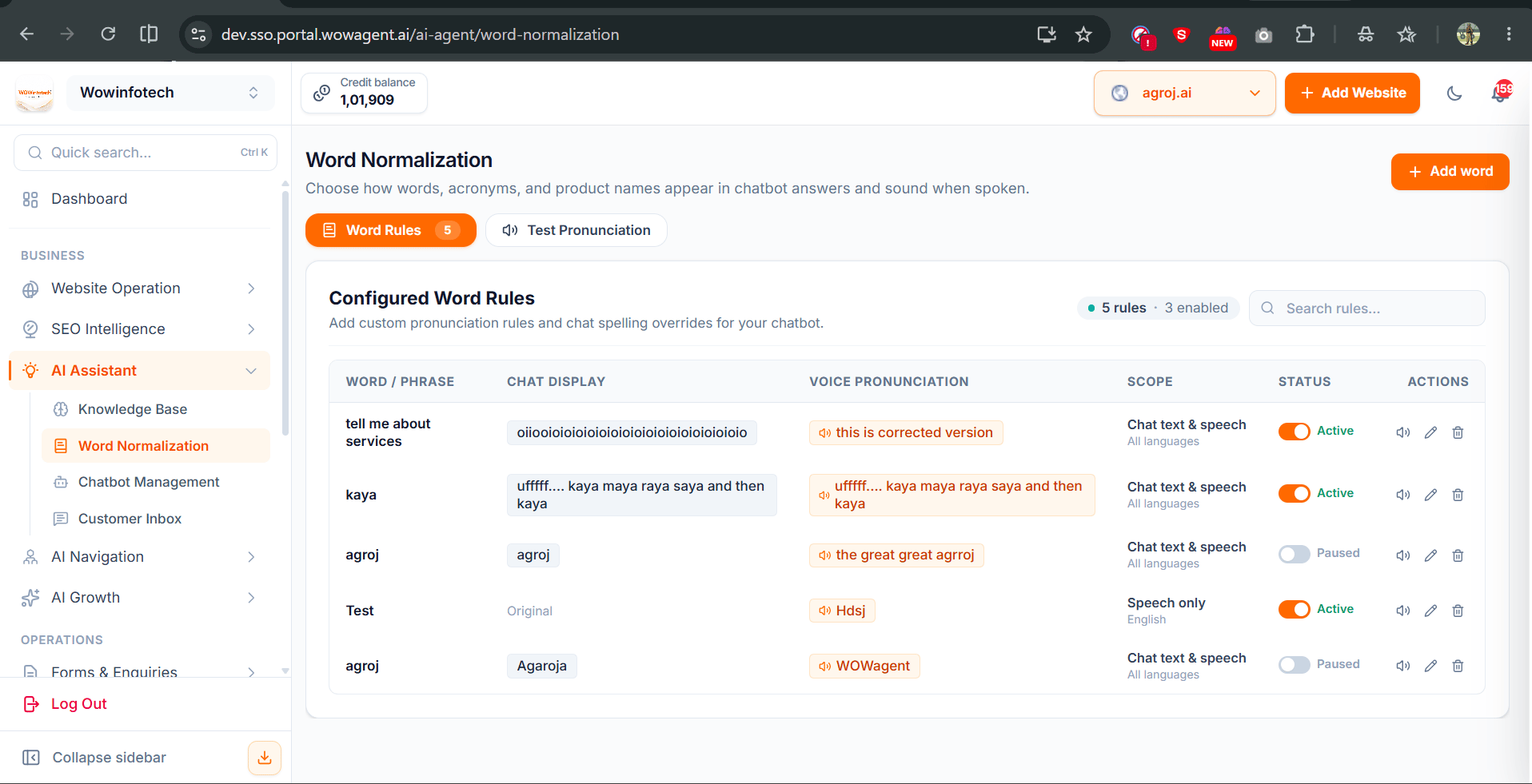
Use Search rules to find a rule quickly. The counter above the table shows the total number of rules and how many are enabled.
Add a Word Rule
1
Click Add word
Click Add word at the top right of the Word Normalization page.
2
Enter the original word
Enter the main word or phrase you want to normalize, for example
wowinfotech. This field is required.3
Add aliases (optional)
Add other spellings or forms of the same word, for example
wow infotech or WOW-Infotech. You can add up to 12 aliases.4
Choose where the rule applies
Choose chat text, speech, or both.
5
Enter the display and spoken spellings
Enter the chat display spelling (for example
WOWInfotech) and the voice pronunciation (for example Wow Infotech). Which fields are required depends on the scope you chose. See Rule Fields.6
Choose a language
Select All languages, English, Hindi, or Marathi.
7
Save the rule
Save the rule. New rules are active by default.
Rule Fields
Edit, Pause, or Delete a Rule
- To change a rule, click the edit (pencil) icon in the Actions column.
- To stop using a rule for a while, switch its Status toggle to Paused. Paused rules are kept but are not applied, and they do not cause conflicts with other rules.
- To remove a rule permanently, click the delete (bin) icon.
- To hear how a rule sounds, click the speaker icon.
How Rules Are Applied
Each rule works on the channel you choose:- Chat text only: replaces the word in chatbot answers shown on screen.
- Speech only: replaces the word only before the voice assistant speaks. Chat text stays unchanged.
- Chat text & speech: shows the display spelling in chat and uses the spoken spelling for voice.
- A language-specific rule takes priority over an All languages rule.
- The longest matching phrase is processed first. For example, a rule for
WOW Infotech servicesis applied before a rule forWOW, so the shorter word does not break the longer phrase.
Test Pronunciation
Use the Test Pronunciation tab to check how a sentence will look in chat and sound when spoken, before your visitors see it.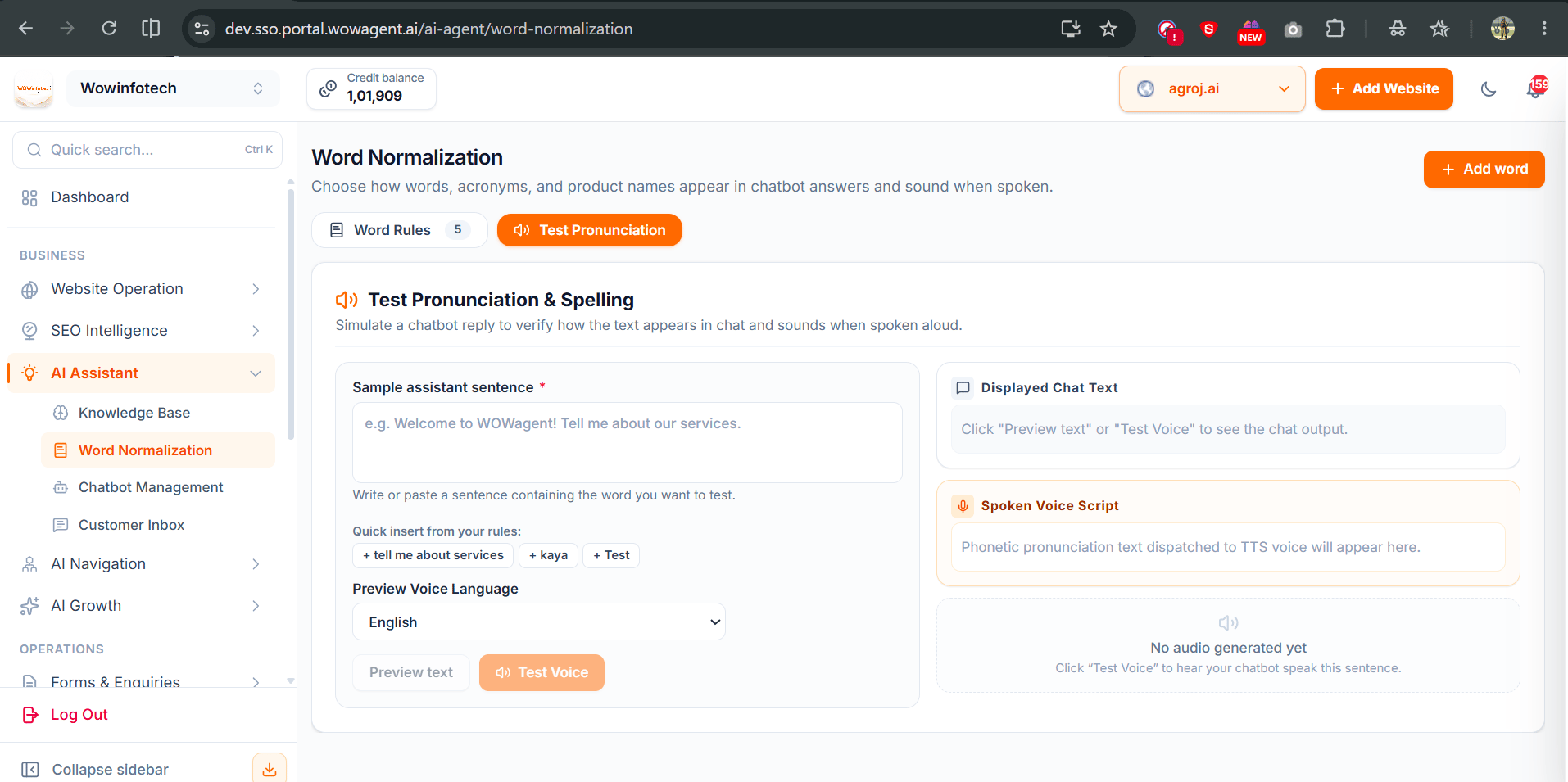
1
Open Test Pronunciation
Click the Test Pronunciation tab.
2
Enter a sample sentence
In Sample assistant sentence, type or paste a sentence that contains the word you want to test. You can also click a word under Quick insert from your rules to add it.
3
Select the voice language
Choose a language in Preview Voice Language.
4
Preview the text
Click Preview text. Displayed Chat Text shows how the answer appears in chat, and Spoken Voice Script shows the text sent to the voice.
5
Test the voice (optional)
Click Test Voice to generate and play an audio sample.
- Not be empty.
- Be 900 characters or fewer for a text preview.
- Be in English, Hindi, or Marathi.
Audio Preview and Credits
When you click Test Voice, WOWagent:- Uses your website’s voice settings and the voice for the selected language.
- Supports samples up to 2,500 characters.
- Checks your voice credit balance before generating audio.
- Deducts credits only if the audio is generated successfully.
Supported Languages
- English
- Hindi
- Marathi
- All languages
Protected Content
Word rules never change the following content, so links and technical text keep working:- URLs
- Email addresses
- Domain names
- Inline code and code blocks
- Link destinations
- HTML tags
Rules and Limits
Every rule is checked before it is saved:- All required fields must be filled in.
- Only plain text is allowed.
- Words, aliases, and replacements can be up to 120 characters each.
- Each rule can have up to 12 aliases.
- The original word or alias must contain at least one letter.
- Only supported languages can be selected.
- The display and spoken spellings must match the selected scope.
Conflicts Between Rules
Two active rules cannot use the same term for the same language and channel. WOWagent checks for duplicates across:- Original words
- Aliases
- Display spellings used by speech rules
agroj with different replacements.
Next Steps
Chatbot Management
Configure your AI assistant’s voice and behavior.
Knowledge Base
Train your assistant with your business data.